Tuesday, January 22, 2013

Cheap Flight Skills


I would like to provide assistance in helping you find the cheapest flight possible.  
As most of you do not travel that often, perhaps you do not know the sort of tricks and ideas that I can provide on buying flights. In no way are these official rules or are they 100% correct, but they will offer some ideas into the cost that you are seeing. 

WHEN TO BUY
First of all, I honestly believe that if you were to search for a ticket in January for July, the price would be astronomical and, more importantly, it won’t change for at least the next few weeks. The reason that the prices are so high is that it is much too early to buy plane tickets. Airline tickets only become available to be purchased eight months before the date. The people who need to buy tickets that early in advance are either a) business types that need a specific flight for a specific meeting b) rich people or c) people who don’t know the industry and are worried that the tickets will sell out or get more expensive. Nothing could be further from the truth. 

One has to consider when most people buy their tickets to travel and the answer is usually a few months before (like three). As you get closer to your traveling date, you will see the price begin to fluctuate as promotions and ticket sales begin. Now I’m not saying that you have to wait for three more months, but I want you to understand that the price fluctuates constantly to meet the demand. Right now there is no demand, so the price will not fluctuate much. 

To get the best price for nearly anything, you need to understand how much it is worth. To do that will require a lot of time but if you are determined you can buy a $1500 ticket for $650. 

The first guidance I can suggest is: Do not buy tickets on evenings and weekends. Monday, Tuesday, Wednesday and maybe Thursday during the day between 11:30-2pm is the best time to buy tickets. The reason is that when the airline offices are open the price will fluctuate in relation to demand. However, during lunch hours demand will be low and as a result the prices drop to attract attention. In the evenings and weekends the demand is up but as the offices are closed they do not put on any specials, so super sales will be rare. 

The 11:30-2pm zone is dependent not on where you live but on where the headquarters of the airline is. If you check during these times in east Canada/US then you are likely to get the best prices for Canadian and American flights. If you check at 7:00am (12:00pm UK time) then you may get some deals with UK companies or maybe French, Dutch or Spanish ones. 

WEBSITES
The websites I check are Jetcost, Skyscanner and airtransat (Airtransat is mainly for people flying from Canada). There are others of course – please let me know if you find any other good websites.
To understand how much the ticket is worth, you have to see what the general price is and how it changes. Yes, I do this in a rather compulsive manner, but I find it the most useful in the long run. Take a piece of paper and fold it in two. On the top of the page, write the website you are going to use (i.e. Jetcost) and the date and time of day. This will keep track of when you did your homework. On one side of the page, write the most convenient airport to you, and on the other the airport(s) that you could go to. For instance: Ottawa and Montreal. Montreal is available for Ottawa people as the bus there is not that expensive. In fact, this may save you a lot of money as it is a much large hub than Ottawa.
In the first column, write the days you wish to travel (for instance July 14th to July 24th). Under this, make a matrix that looks something like this:
12 -21 = _______     13 -21=______         14 -21=_______      15  21=_________
      -22 = _______          22=______                22=_______           22=_________
      -23 = _______           23=______                23=_______            23=_________
      -24 =  _______          24=______                24=_______            24=_________
      -25 = _______           25=______                25=_______             25=_________
       -26 = _______          26=______                26=_______             26=_________

This will give you an idea of how much the price changes from day to day depending on the day you leave and come back. And I guarantee you will see a huge variation. If you don’t, then either you are buying a ticket too early (no demand) or at a time when the offices are closed (standard price). On the other side of the page, do the same search for the other airport. I sometimes check Jetcost and Skyscanner at the same time and make one sheet but you can make two if it helps you keep track of what you saw where. Airtransat is the only company that I know of that flies from Ottawa to London Gatwick directly.

If you do this on Monday at 11:30, then do it again the following Monday at 11:30 and you will see which flights are in more demand and which are less in demand, which flights are getting cheaper and which are getting more expensive. Do this at different times of the week over the course of a few months and you will soon see which flight is the cheapest, and on which day, and have an idea of when the best time to buy that particular flight will be.

The other advantage of doing this is that if you see a crazy sale you can jump at it.

Where are you flying to?

One would assume that if you want to fly to London, you would search for London. Not necessarily. There are a few hubs in Europe that have large airports and thus more possibilities: London, Amsterdam, Zurich, Frankfurt, and Paris. All of these are great hubs and giant airports.

Once you are in Europe, the duty on flights drops dramatically. There are low-cost airlines that can take you all around Europe for very little. In this circumstance, it is usually better to buy tickets earlier as the demand is higher because the tickets are so much cheaper. Money Saving Expert flight checker searches Monarch, Flybe, Easyjet and Ryanair, all the low-cost airlines, so you can get a flight from Paris to London for $50 or even less. So in the above system- you can make multiple sheets for different destinations. Do bear in mind that they charge extra for luggage, so you need to take that into account when looking at prices. Also, Ryanair will charge you an admin fee and payment fee no matter which method you use. Most of the others will charge a fee if you pay with a credit card, although it is free to pay by credit card.

Sunday, January 13, 2013

Star Wars Episodes 7,8,9

Hey guys.

I have my theory for Star Wars Episodes 789 and its a sold theory.

The story of Luke Skywalker is told from the time he is 18 years old to 22 years old. This is paralleled with the story of Anakin Skywalker. Yes Anakin was 9 at the time of Episode 1 but by Episode II he was 19 and Episode III he was 22. One could suggest that continuing the same pattern and telling the story of Ben Skywalker in and around when he is the same age would be appropriate. Thus as he was born 26.5 years after EPIV he would be 18 by 44.5 after EPIV. This would be just after Fate of the Jedi Apocalypse as it takes place in 44 years after EPIV.  Its is yet unclear when Star Wars Crucible and Sword of the Jedi takes place. As I see it placing 7,8,9 here keeps everything made in continuity and opens up a new area to explore.

Second argument. Return of the Jedi came out in 1983 and episode 7 will, probably, come out in 2015 - 32 years later. Thus all the actors are 32 years older. If you place the movie 40 years after Return of the Jedi the characters would be aged by 40 years. You will have actors that are 32 years older playing characters that are 40 years older. If the films continue the pattern that the other three films did with a new movie every three years and the story of Ben Skywalker ageing from 18 to 22, Episode 9 will be out in 2021. At this time the actors will be 38 years older playing characters that are 44 years older. No matter the age of the actors, it would seem appropriate to have the story in and around this time.

I would love to hear what you think of that.
Cheers
Michael.

Monday, December 31, 2012

2012 in Reflection


The end of the 2012 ­– not the end of the world as I was led to believe – is here and I wanted to wish everyone the best for this Holiday Season. I hope everyone had a great year and that everyone is plotting and planning to make 2013 a great one. 2012 for me ranks up well against other years but still doesn’t beat 2009, the year I moved to Japan. However, if my machinations come to fruition, 2013 may be the best yet.

We spent this year living in Lancaster and, hopefully, this coming January we will be moving to Holland. In all, we will have spent 16 months in the UK. Helene set up her translation business and loves what she does. One of her contractors is a film company and she translates films like ‘Skyfall’, usually commentaries for the DVD. I have been finishing my two Master’s degrees: one from my University in Kyoto in Japan, where I studied last year, and the second at Lancaster University.

The year started a bit pressured as the first round of papers was due.  Once they had been submitted, we had a great weekend in London as Helene was writing an exam for the Chartered Institute of Linguists. Six months later, we learned that she had passed with Distinction. Now she has DipTrans (IoLET) added to her name, making her a certified translator.  We also saw the London West End show ‘Rock of Ages’ – now a hit movie – very funny.  Later, I helped organise three events related to Holocaust Memorial Day, including speaking at various schools.

Between February and July, I blogged for a Spanish organisation called Universia where I wrote articles on education in the UK from a foreigner’s perspective. The articles compared Canadian, Japanese and UK teaching styles and university practices. I also wrote beer articles for the Langdale Drinker, as I’ve been researching the history and art of brewing beer.  

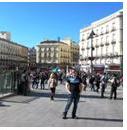
In February, I had a spontaneous wonderful four day trip to Madrid with my friend Anas, where we may have had too much fun and ended up with questionable results. The walk home from the two clubs will go down in history. Got the flu and judged the Lancaster Beer Festival with a fever. Another trip to London where my class visited the UK Foreign Ministry and we saw the rooms Canada, India and the rest of the Empire were ran from.

In April, I got a visit from Tavis Moffat, which started a 7-day pub crawl that ended with wild hog sandwiches in Edinburgh. Ate Haggis for the first time – loved it. Soon afterwards, Corey Longmore delivered his own baby and named me the Godfather. The month ended with wonderful week in Switzerland where I visited a few towns and then our class visited the UN, WTO, the Red Cross, and the Green Cross.
Helene won tickets to the Queen’s Diamond Jubilee celebrations and another quick trip to London was due. Canada Day is still way better. The trip tied in nicely with a reunion in Devon of friends from my time in Paris.

Spent two months finishing my thesis for my Japanese university and then traveled there in July to present it. Not only did I receive the highest grade point average, my thesis was also published in my school’s periodical. The three weeks in Japan were incredible – seeing friends and visiting old favourite places while eating incredible food. I miss Japan immensely and wish to go back soon. Helene came to join me and we had a short side trip to Obama where we ate fugu (blowfish) and swam in the northern Japanese sea. In September, I obtained my M.Phil in International Relations from Ritsumeikan University. Thanks to all those who supported my return to school.

The lease to our apartment was up at the end of September, so we decided to move across town. Now I live in the centre of Lancaster, giving me a 5-minute walk to the movie theater.

August through to October was filled with writing my second thesis. My aim was to write the best possible paper so that I could choose any university for my PHD if I ever decide to do one. I hope to get my second thesis published as well. My final score was equivalent to a 98% and I graduated in November with a Distinction, receiving an MA in Diplomacy and Foreign Policy. I got word that one of the papers I wrote this year will be published in an academic peer-reviewed journal in the upcoming year.

Saw Bowling for Soup live. Manchester Independent Brewers convention at the stunning Victoria Baths, with Fabien and Joel. Visited Helene’s Aunt Lyn and Uncle Tommy and searched for wedding venues, as next July I will be celebrating my wedding not too far from London. Visited Helene’s grandparents near Southampton and saw the 50 years 50 vehicles of James Bond exhibit.  

In December, I was accepted to a week course in Munich at the NATO School where I learned about civil-military cooperation. I figured if I want to work for or with NATO, I should learn how the organisation works. Made a crazy amount of connections and learned a lot. Helene and I also got to enjoy the Christmas market in Munich. No one does Christmas like the Germans. 

The year ended a visit from Helene’s brother Pierre to our little city in the north. I took him to see Manchester vs. Sutherland at Old Trafford Football stadium (soccer for the North Americans). Later that week, we stayed with Fabien in Paris for a few days and a then had a 7.5 hour drive to Toulouse for the holidays with Helene’s parents. Though the turkey and sides were wonderfully well prepared and delicious, the tummy bug that enveloped Pierre’s girlfriend found its way to me and I spent Christmas Eve and Day violently ill. The leftovers were amazing.  

Spiritually, I have started writing a journal with my personal reflections about myself and the world. Helene and I met Joel, a local priest, who has helped us explore more metaphysical ideas of our spirituality, and this has brought us closer together as we understand more of where we are coming from. Our sessions encouraged me to explore my ideas more deeply. 

I have become better connected with British culture, food and lifestyle. Had a chance to see the country a bit and make some really good friends. From the big-city vibe of Manchester to the wide open horizons of Morecambe Bay and the hills and valleys of the Lake District and Yorkshire Dales where there is good walking, I enjoyed this region! But the weather is terrible. It forever feels like November, cold and usually raining. I also became an artisan on making English style homemade pies – ask me for a recipe.  About to reach my 1000th beer review on ratebeer.com

My time in the UK has been wonderful but after our trip to Japan, Helene and I realise that it’s just too similar to what we know. We love the challenge of language and culture and are really looking forward to moving to the Netherlands.

Wishing you all a Happy New Year 2013, filled with joy.

Love,
Mike

Saturday, August 18, 2012

Nemesis Beer and the Japanese Craft Scene


There are two ways to understand Japanese beer. If you go to Japan and ask 99.99% of Japanese citizens, they will only be able to tell only tell you about one kind of beer: the mass produced tasteless swill that most people drink. The other kind of beer is Japan’s craft beer movement, which sadly only has a small following in Japan. Most people in the world and, yes, most people in Japan, don’t know that Japan is one of the highest beer producers in the world when it comes to the number of beers produced. No other Asian nation – and very few European nations ­­–­ produce the same amount of beers as Japan’s craft beer movement.

In my time in Japan, I searched high and low in each restaurant and pub to find a beer that wasn’t one of the 10 mass-produced pale lagers. Eventually, I found small shops and dark corners in Kyoto that sold a few. Over the course of two years, I tracked down about 120 Japanese beers and am only now realising that there are over 3,000. In my last days there, I visited a Japanese beer museum that was assembled by one Japanese man over the course of just 4-5 years. It proves that Japan is a brewing nation. 

What is really interesting is what they brew. Unlike the UK, where even the smallest brewery has some level of distribution in place, most Japanese beers come from small microbreweries that usually only sell to locals while 99% of the market is dominated by 10 beers. By locals, I mean that one or two places may sell the beer occasionally; otherwise the beer is either consumed by the brewer or sold to the happy few that live near the brewery. And since Japan doesn’t have a history of beer, their definition of brewing is really different and experimental.  Each and every Japanese craft beer could be in a style common to any brewing country, from Australian Lagers to Russian Stouts. There are some truly horrible green tea beers and some truly marvellous Imperial Chocolate Stouts. Although the UK has a long history of brewing, it doesn’t have the variety and randomness of drinking a Japanese craft beer, which could taste like almost anything.

I currently review the beers that I have drunk on ratebeer.com, which is – I think – the largest beer database on the Internet and have over 700 reviews at present. I have added many English and Japanese beers as well as a few others to their database, and was occasionally among the first to review them. Such a pleasure is generally rare however as the database is rather substantial. Most beers I come across have usually been rated by more than a handful of people, with general amount of reviews for most beers being between 200 and 5,000. So, outside of Japan, I usually expect the beer I drink to be already in the database.  Most beers that can be found internationally are listed on ratebeer.com.

However, I recently came across a strange anomaly. I visited Japan again this summer and found myself in a quieter area of Kyoto where I came across a small liquor shop. I popped inside, as I usually do, to see if it had anything interesting. Now, by this point, I knew most of the foreign beers that I was likely to find after my time in Japan, but I was surprised to find a new one. In this little quiet sake shop that sold the 10 Japanese common lagers as well as the 10 common international lagers like Budweiser and Heineken, I found a bottle of Samichlaus Classic Malt Liquor, 14%, from Austria. I thought it would be interesting to try it since I’ve never had a malt liquor before, but I was appalled at the charge of £7.50. In my mind, a malt liquor was a beer-type product somehow lower in quality and cheaper to make than a simple pale lager. I believed malt liquor to be the cheapest kind of beer available and therefore generally used for those who are financially limited but still want to get drunk. It certainly wasn’t something I was willing to pay £7.50 for and so the beer was discarded.

Boy was I shocked when I found it in Lancaster, examining the beer fridge at the Sun Hotel. I had never seen this beer before, I found it for the second time in two weeks and it had only been rated 8 times on Ratebeer. How could this unpopular, most likely poor quality beer find itself across the planet in the most random of places? I knew that this time, regardless of the cost, I needed to taste it and see what it was. To my surprise I was charged the same £7.50.

Pouring the beer, I truly expected it to be horrid. How could it possibly be good with the image that malt liquor has? Now, I would like to think I have an idea what good beer tastes like and this beer was incredible: one of the best beers I have ever had. It was a complex German lager. This beer needs to be aged for 5 years (the bottle says best before 2017) and drunk with chocolates. It gave me a new definition of what beer is.

Marsiblursi (2781) from Göteborg, Sweden explains it perfectly on ratebeer.com:
Pours an oily dark brown with orange to red highlight. Small head. The aroma holds buttery oak up front with note of wood shop, coconut, salted peanuts and light vanilla. The malt is all about toffee-ish and fudge-like caramel. Undertones of brown sugar, warming alcohol, leather, cherry jam, resin, prunes and figs. The nose is not complex but super mega uber yummy (and I take yummy over complex any day). The flavour is medium to heavily sweet, light bitter and tiny acidic. Super oaky and brutal malty. Undertones of dark sugar and dark fruits. The mouthfeel is round, soft and light sticky with a near light to medium carbonation. Light astringent, light numbing (from the well hidden, light woodsy alcohol), super buttery and caramelly finish. Lingering aftertaste. Medium to full bodied. Typical top 50 material, too bad it isn’t more available.

What is the lesson? Always try something new when you can. The name ‘Malt Liquor’ shows something strange about naming and laws rather than the style itself. So another lesson is: don't believe the style on the label. It’s not a malt liquor as the name is understood now, in the way a barley wine is not a wine! 

Thursday, August 2, 2012

Negotiation Exercise - Syrian Crisis

Syrian Crisis Negotiation  <- Click here for the video
This is a video of a negotiation we did in class about UN peacekeepers in Syria in March 2012. It gives you an outline of the sort of things covered in the class and the kind of things I have to learn about. In the video I make a small speach at the end so keep watching.


Friday, June 15, 2012

British beer from a Canadian viewpoint


The sign suggests beer and lager are different when they're not.

 *This article appeared in issue 14 of the Lunesdale drinker


The pub-centred culture of beer drinking in Britain is surprising from a Canadian point of view, mostly because here nearly all drinking happens in a pub. Draft beers and the pub system seem to work in excellent unison and the cost makes a social gathering easy and affordable. By contrast, in Canada, going out for drink is a planned, coordinated and costly event, thus most beer will be drunk in a domestic setting. I much prefer the social atmosphere of a nice pub.  

For clarification, it’s important to explain what I mean by the word ‘beer’. By ‘beer’, I don’t mean ‘Bitters’. For some strange reason, in Britain the word ‘beer’ seems to be synonymous with a ‘Bitter’ or some variation of a ‘Bitter’, like a ‘Best Bitter’, or ‘Premium Bitter’. Occasionally, the word ‘beer’ is used to refer to ‘Ale’. “Beer is Ale and Lager is Lager” is an expression I’ve heard on more than one occasion. Actually, this is entirely a fallacy but it is understandable given the beer drinking culture of the UK. 

When I use the word ‘beer’, I am in fact referring to a huge variation of recipes. This essentially encompasses all forms of Ales, Lagers, Limbics and various different styles mixing the three. The historical processes of beer-making in various countries have produced a wide range of beverages that don’t even come close to a ‘Bitter’. Depending on which database you are using, there can be as many as 80 different types of beer in the world*. Many Britons have no idea what I’m referring to and understandably so.

Here in Britain, after examining the various beer festivals, pubs and off-licence stores, some people might be surprised to know that there are 12 styles of beers available: Pale Lagers, Premium Lagers, Pilsners, Porters, Stouts, Strong Ales, Milds, Golden/Blond Ales, IPAs, Old Ales, Bitters/Pale Ale, Best Bitters/Premium Bitters/Extra Special Bitter (ESB) (no one has yet been able to explain the difference to me and they are often used synonymously). There may be some Barley Wines and other specialties but they are super rare. This list may seem impressive but the problem that I find is that nearly 80% of all beer that I can get a hold of is a Bitter, Golden Ale or Premium Bitter. Finding anything else can be a chore. These are usually the core three beers of any brewery. Unfortunately, I find that my palate has become tired of drinking ‘Bitters’ and I crave for more variability. Canada and the US have incorporated brewing styles from all over the world, which keeps the market interesting.   

Even with the limited range of styles, it must be said that most of Britain’s beers are quite good. The average beer is typically very drinkable and enjoyable. But there is a certain level of mediocrity connected with this, as the average beer tends to be just that: although there are few terrible beers, incredible beers are just as hard to find.

Lastly, I wanted to say that Cask is generally hard to find outside of Britain. This is something that really defines the British drinking culture and I believe you all have CAMRA to thank for that. A Cask variant or bottled conditioned beer is highly unorthodox and incredibly uncommon to find in almost any other country where all beer are pasteurised. I would love to see some of my favourite beers in Cask form. Cask is definitely my preferred way to enjoy beer.  

* Japanese Sake is often translated as rice wine. However, unlike wine, in which the sugars present in the grapes are fermented, the brewing process of Sake is closer to that of beer. ‘Rice beer’ would actually be a more accurate term than ‘rice wine’.